In precision automation, two terms appear again and again: accuracy and repeatability.
They are often used interchangeably. But they describe two very different aspects of machine and robot performance.
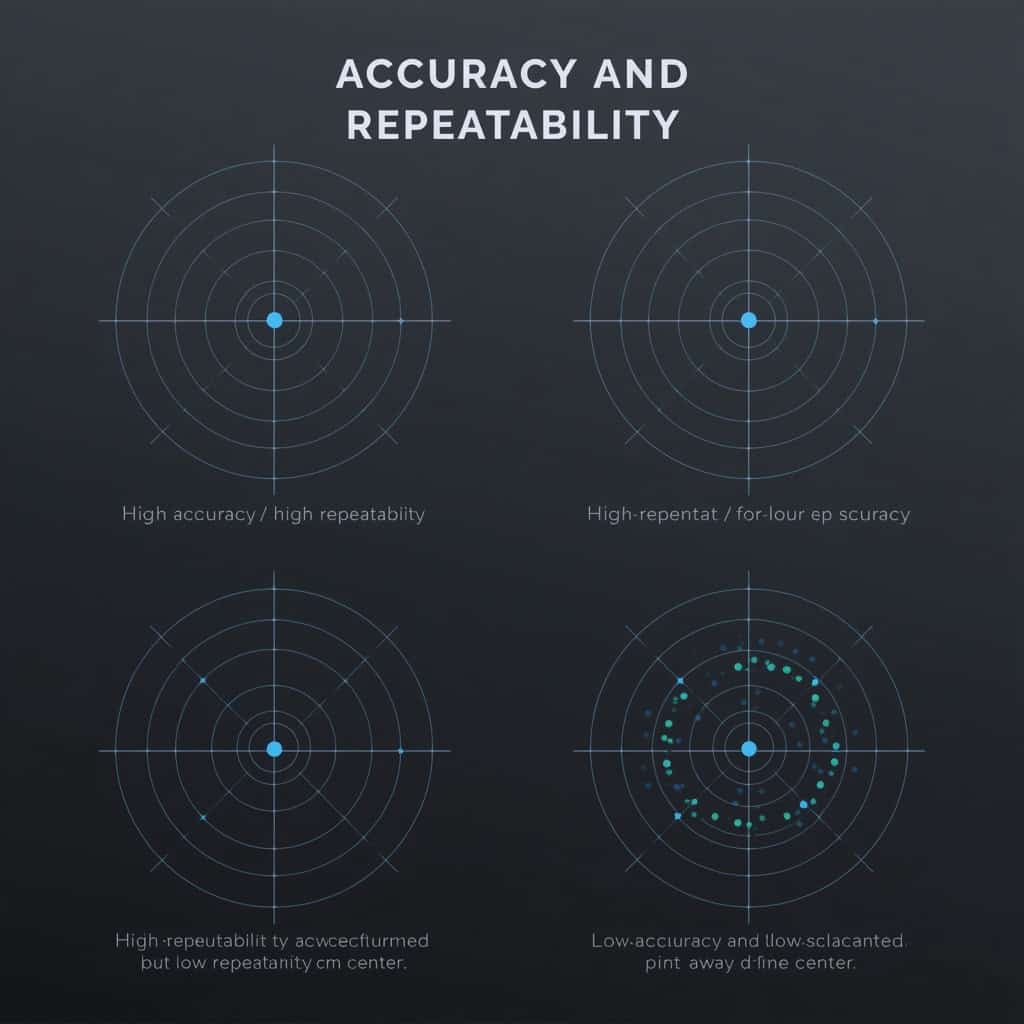
A system can be highly repeatable without being highly accurate. It can also be accurate in one position but struggle to repeat that position consistently.
Understanding the difference is essential when designing or specifying a motion control system.
Repeatability: Can It Do It Again?
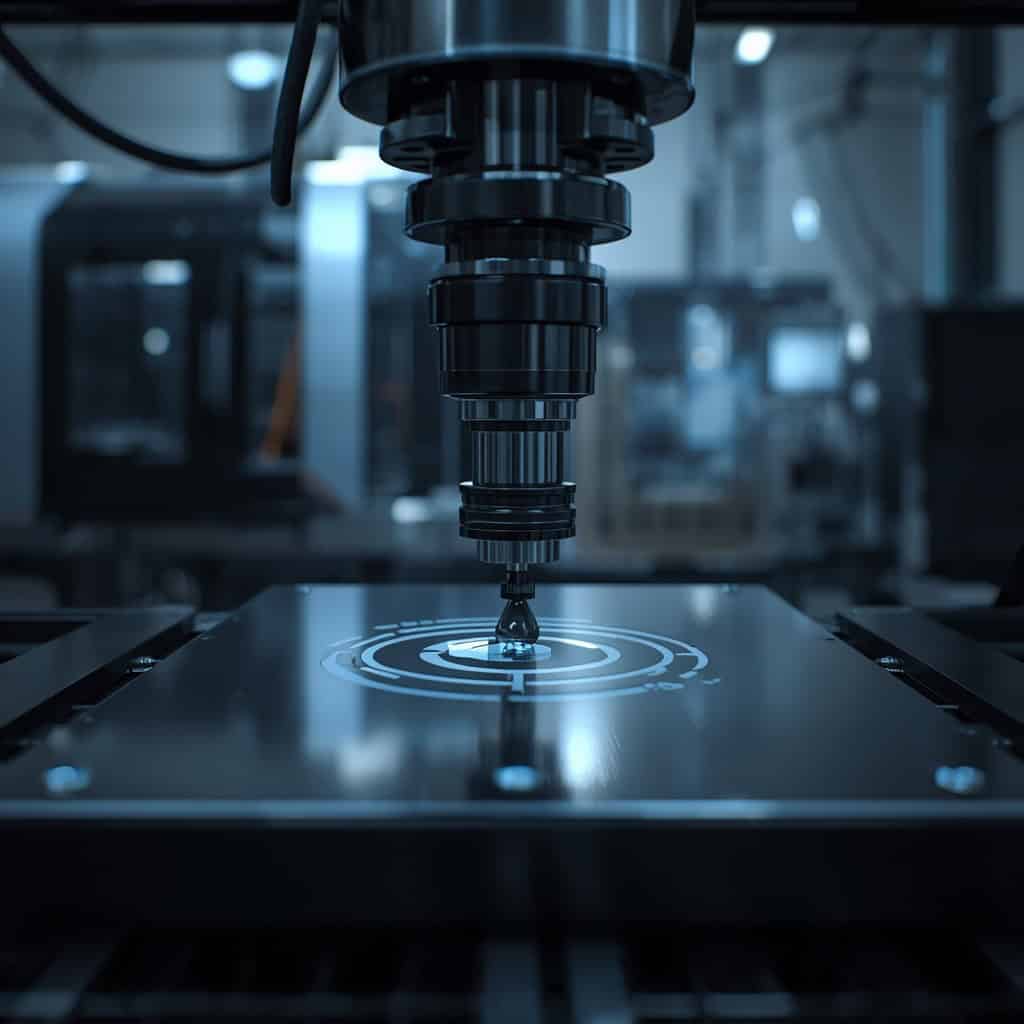
Repeatability describes a system’s ability to return to the same position or achieve the same movement consistently.
Imagine a robotic arm picking a component from a fixture.
On the first attempt, it reaches a position 0.3 mm away from the desired location.
On the second attempt, it reaches almost exactly the same position.
And on the third, fourth, and fifth attempts, it does the same thing.
The robot is highly repeatable.
However, if the target position is somewhere else, the robot may still be consistently wrong.
Repeatability is therefore about consistency.
It answers the question:
“Can the system return to the same position over and over again?”
In many industrial applications, excellent repeatability is critical. A machine may perform the same operation thousands or millions of times, and small variations between cycles can affect product quality, assembly, and throughput.
Accuracy: Did It Reach the Right Position?
Accuracy describes how close the actual position is to the intended or commanded position.
Using the same example, suppose the robot is commanded to move to a specific point.
If it reaches that exact point, the system has high positional accuracy.
If it consistently stops 0.3 mm away, its accuracy is lower—even if it returns to that same incorrect position every time.
Accuracy answers a different question:
“How close is the actual position to the intended position?”
This distinction becomes especially important in applications where the machine must know not only that it can repeat a movement, but that the movement corresponds precisely to the required physical position.
A Simple Example
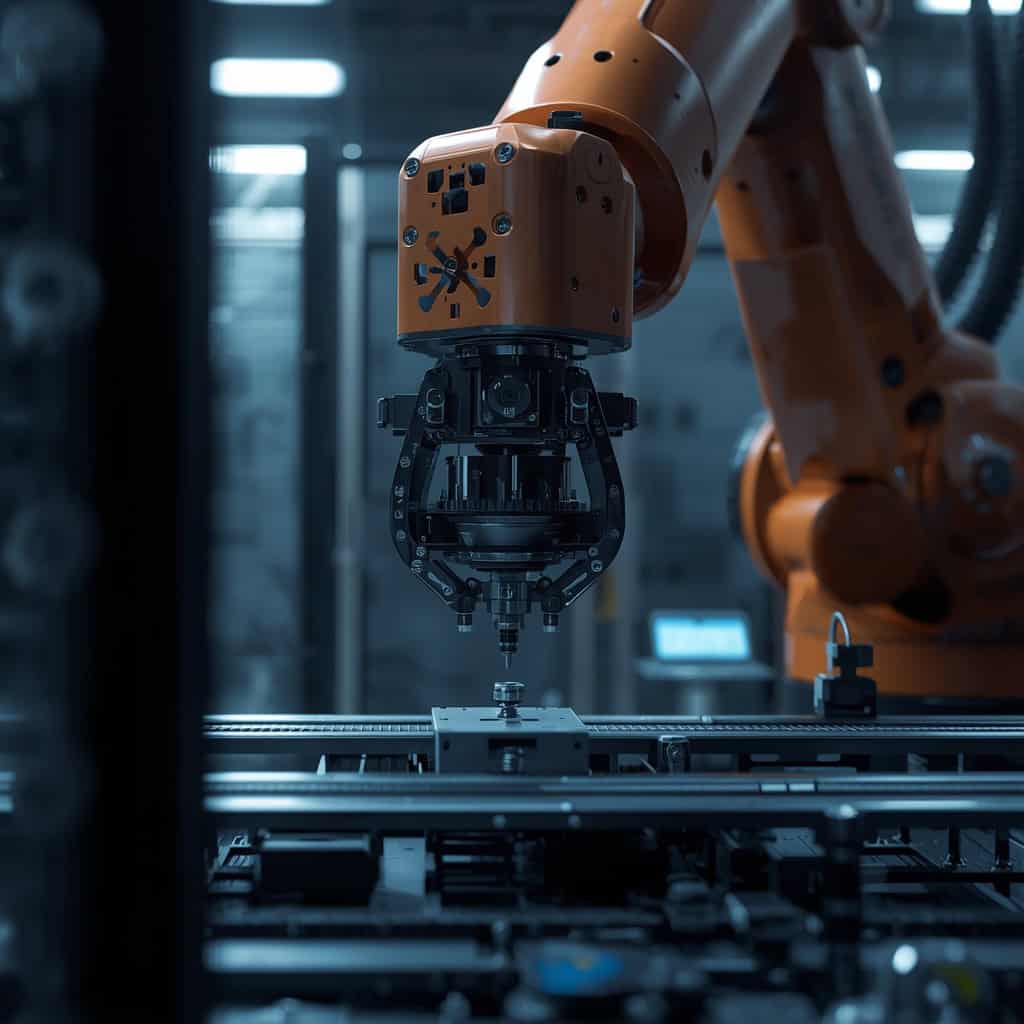
Consider a robotic arm placing components onto a circuit board.
Scenario 1: High repeatability, low accuracy
The robot places every component 0.3 mm to the left of the intended position.
The results are extremely consistent.
Repeatability: Excellent
Accuracy: Poor
The robot knows how to return to the same position, but that position is not the correct one.
Scenario 2: High accuracy, low repeatability
The robot’s average position is very close to the target, but each movement varies slightly.
Some components are placed exactly where they should be. Others are 0.1 mm away, 0.2 mm away, or more.
Accuracy: Good
Repeatability: Poor
The system can reach the correct area, but it does not do so consistently.
Scenario 3: High accuracy and high repeatability
The robot consistently reaches the intended position with minimal deviation.
Accuracy: Excellent
Repeatability: Excellent
This is the ideal situation for many high-performance motion systems.
Why Does the Difference Matter?
The required balance between accuracy and repeatability depends heavily on the application.
A machine performing a repetitive assembly operation may place greater emphasis on repeatability.
An inspection system, on the other hand, may require extremely high accuracy because it needs to measure the actual position or dimensions of a component.
And some applications require both.
Assembly
In automated assembly, repeatability is often critical.
If a machine repeatedly inserts a component into the same location, variation from cycle to cycle can cause alignment problems, mechanical interference, or inconsistent assembly quality.
However, repeatability alone is not enough if the machine was never correctly calibrated to begin with.
Inspection and Metrology
Inspection and metrology applications place much greater demands on accuracy.
A measurement system must know where the sensor or inspection tool actually is—not simply that it can return to the same position.
Small positioning errors can translate directly into incorrect measurements.
Semiconductor Manufacturing
Semiconductor equipment operates at extremely tight tolerances.
Positioning systems may need to move components, stages, wafers, or inspection equipment with exceptional precision.
Here, accuracy, repeatability, resolution, thermal stability, mechanical design, and feedback all become part of the overall performance equation.
Medical and Surgical Robotics
Surgical robotics presents an even more demanding challenge.
A robotic system must repeatedly execute controlled movements while also maintaining highly accurate positioning.
In these systems, mechanical precision alone is not enough. Sensors, feedback, calibration, control algorithms, and system architecture all contribute to performance.
Collaborative Robots
Collaborative robots can use additional technologies to improve practical positioning performance.
Vision systems, external sensors, calibration routines, and software compensation can help the robot account for variations in its environment.
This highlights an important point:
The robot’s mechanical accuracy is only one part of the overall system.
Where Do Encoders Fit In?
This is where motion feedback becomes particularly important.
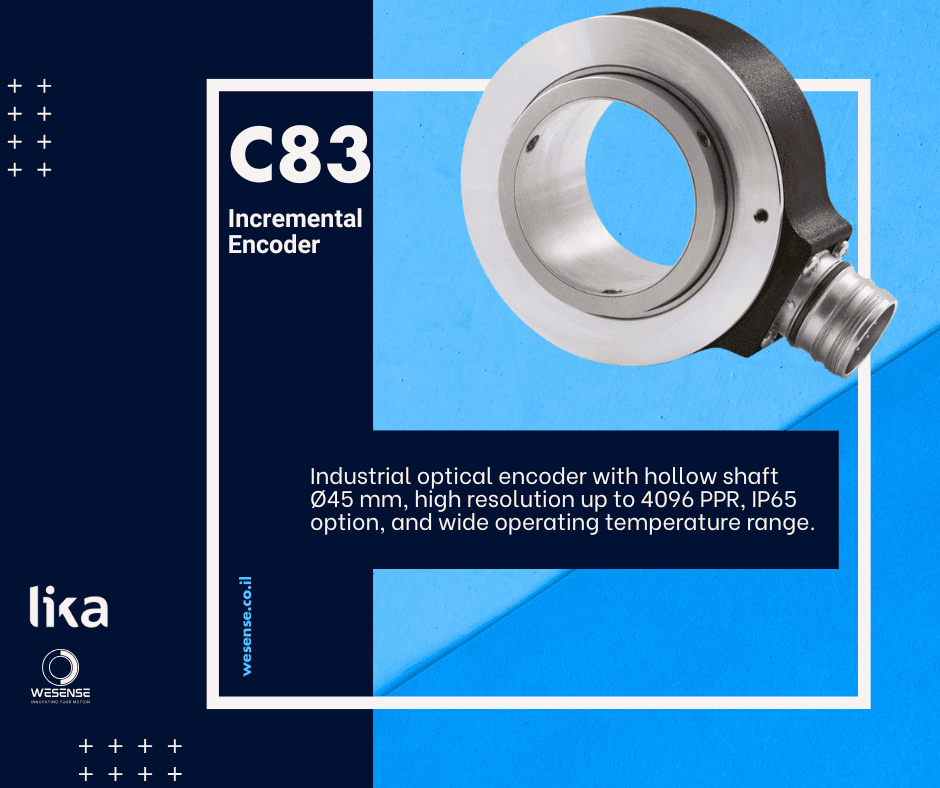
An encoder provides position or motion information to the control system. Depending on the application, an encoder can measure rotary or linear movement and provide absolute or incremental feedback.
The encoder itself does not automatically make a machine accurate.
Instead, it provides the control system with information about what the machine is actually doing.
That information can then be used to detect position errors and adjust the motion.
For example, if a motor is commanded to move to a specific position, an encoder can provide feedback about the motor or mechanical system’s actual position.
The controller can then compare:
Commanded position → Actual position
and respond to the difference.
This feedback loop is fundamental to modern precision motion control.
Accuracy Is More Than the Encoder
It is tempting to look at encoder resolution and assume that a higher-resolution encoder automatically means a more accurate machine.
It doesn’t.
Overall system accuracy can be influenced by many factors, including:
- Encoder accuracy
- Encoder resolution
- Mechanical backlash
- Bearing runout
- Structural deformation
- Thermal expansion
- Installation errors
- Alignment
- Vibration
- Drive performance
- Control algorithms
- Calibration
- Load conditions
A very precise encoder installed on a mechanically inaccurate system cannot eliminate every source of error.
This is why precision motion control is ultimately a system-level engineering challenge.
Resolution, Accuracy, and Repeatability Are Not the Same
There is another term that is often confused with accuracy: resolution.
Resolution describes the smallest change in position that a system can detect or distinguish.
Accuracy describes how close the measured or achieved position is to the true or intended position.
Repeatability describes how consistently the system can return to a position.
These three characteristics are related, but they are not interchangeable.
A system can have extremely high resolution while still having poor accuracy.
For example, an encoder might detect very small changes in position, but mechanical errors or calibration issues can prevent the overall machine from reaching the correct position.
Calibration Can Change the Equation
Calibration is another major factor in achieving accurate motion.
A machine may have predictable mechanical or positional errors. If those errors can be measured, the control system may compensate for them.
For example, a stage might consistently deviate slightly at different points along its travel.
A calibration process can map these deviations and allow the controller to compensate.
This can significantly improve the machine’s effective positioning accuracy.
However, calibration does not necessarily improve the underlying mechanical repeatability. It primarily helps the system understand and compensate for known errors.
What Should Engineers Specify?
When selecting motion components, it is important to ask more than:
“What is the encoder resolution?”
A better set of questions might include:
- What accuracy does the application require?
- What repeatability is required?
- What resolution is needed?
- Where should the encoder measure the motion?
- What mechanical errors exist in the system?
- Is calibration required?
- What are the temperature and environmental conditions?
- How much backlash or compliance is present?
- Does the application require absolute or incremental feedback?
- How will the encoder communicate with the motion controller?
These questions help engineers select a feedback system that matches the actual application rather than simply choosing a component based on one specification.
Consistency Is Not the Same as Correctness
The easiest way to remember the difference is simple:
Repeatability = doing it the same way.
Accuracy = doing it correctly.
A robot that repeatedly misses the target by exactly 0.3 mm may be highly repeatable but inaccurate.
A precision machine needs to achieve the right balance for its specific application.
And in many advanced motion systems, achieving that performance requires the combination of high-quality mechanics, accurate feedback, appropriate encoders, calibration, and well-designed control strategies.
Because in precision automation, consistency and correctness are not the same thing.