Selecting the right encoder is one of the most important decisions in any motion control system.
The encoder provides the position feedback that allows motors, drives, and controllers to operate with precision. But with multiple sensing technologies available, choosing the right one isn’t always straightforward.
Should you choose an optical encoder for maximum precision? A magnetic encoder for durability? Or an inductive encoder for harsh industrial environments?
The answer depends on the application.
This guide compares the three leading encoder technologies, explains how they work, and outlines the key factors engineers should consider when making a selection.
Why Encoder Technology Matters
An encoder is more than a position sensor—it is a critical part of the control loop.
The right encoder can improve:
- Positioning accuracy
- Repeatability
- Machine reliability
- System efficiency
- Long-term maintenance costs
The wrong choice can result in unnecessary complexity, increased downtime, or performance limitations.
Optical Encoders
How They Work
Optical encoders use a precision code disc and a light source. As the disc rotates, photosensors detect changes in the light pattern, allowing the encoder to calculate the shaft’s position.
Advantages
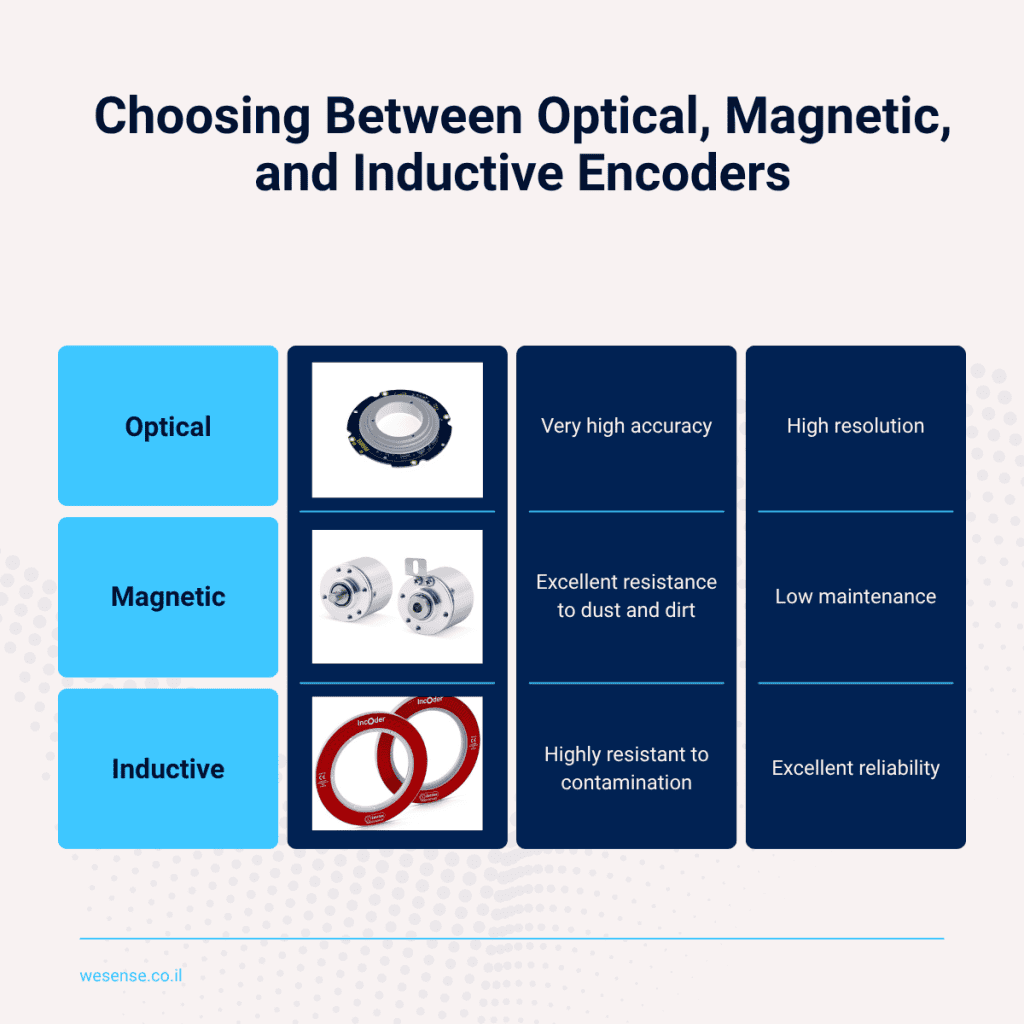
- Very high accuracy
- High resolution
- Excellent repeatability
- Ideal for precision positioning
- Wide range of industrial interfaces
Considerations
Optical encoders typically perform best in clean environments. Dust, oil, moisture, or heavy contamination may affect performance if the encoder is not designed with adequate protection.
Typical Applications
- Semiconductor equipment
- Medical devices
- Laboratory automation
- Precision robotics
- CNC machinery
- Metrology systems
Magnetic Encoders
How They Work
Magnetic encoders measure changes in a magnetic field generated by a rotating magnetic target or a linear magnetic scale.
Modern signal processing converts these measurements into highly accurate position information.
Advantages
- Excellent resistance to dust and dirt
- Performs well in oily or humid environments
- High shock and vibration resistance
- Compact designs
- Low maintenance
- Excellent balance between performance and cost
Considerations
While today’s magnetic encoders offer impressive performance, applications requiring the highest levels of accuracy may still favor optical technology.
Typical Applications
- Industrial automation
- Servo motors
- AGVs and AMRs
- Packaging machinery
- Material handling
- Mobile equipment
- Defense systems
Inductive Encoders
How They Work
Inductive encoders generate electromagnetic fields and measure changes caused by a conductive target.
Because there are no optical components or permanent magnets, the system provides contactless position sensing with excellent durability.
Advantages
- Highly resistant to contamination
- Excellent reliability
- No magnets required
- Compact construction
- Strong resistance to vibration
- Suitable for demanding industrial environments
Considerations
Inductive encoders are increasingly used where environmental robustness is critical, while also delivering high performance for precision motion applications.
Typical Applications
- Industrial robotics
- Factory automation
- Food processing
- Packaging equipment
- Heavy machinery
- Outdoor automation
Comparing the Technologies
Feature | Optical | Magnetic | Inductive |
Position Accuracy | Excellent | Very Good | Very Good |
Repeatability | Excellent | Excellent | Excellent |
Dust Resistance | Moderate | Excellent | Excellent |
Oil & Moisture Resistance | Moderate | Excellent | Excellent |
Shock & Vibration | Good | Excellent | Excellent |
Compact Integration | Good | Excellent | Excellent |
Maintenance Requirements | Low | Very Low | Very Low |
Harsh Environment Performance | Good (with appropriate protection) | Excellent | Excellent |
How to Choose the Right Encoder
Rather than asking, “Which technology is best?”, ask the following questions:
What accuracy does the application actually require?
Not every machine needs micron-level precision. Choosing a technology that exceeds the application’s needs can increase costs without improving overall performance.
What is the operating environment?
Will the encoder be exposed to:
- Dust?
- Oil?
- Coolant?
- Moisture?
- Temperature fluctuations?
- Shock or vibration?
Environmental conditions often narrow the best technology choices.
Is installation space limited?
Compact motors, collaborative robots, and medical devices may require integrated or kit-style encoder solutions.
Which communication interface is required?
Ensure compatibility with the motion controller by selecting the appropriate output protocol, such as Incremental, SSI, or BiSS-C.
What level of reliability is expected?
Applications operating around the clock or in difficult environments often prioritize long-term reliability and minimal maintenance.
How WeSense Motion Can Help
At WeSense Motion, we work with a wide range of optical, magnetic, and inductive encoder technologies from leading manufacturers.
Rather than recommending a single technology, our engineering team works with customers to evaluate the complete application—including mechanics, environmental conditions, controller compatibility, and performance requirements—to identify the most suitable solution.
Because the right encoder doesn’t start with the catalog.
It starts with the application.