
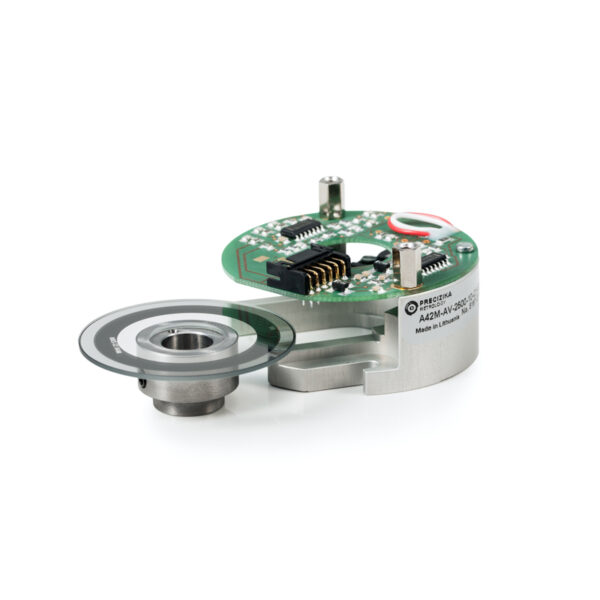
The A42M is a bearingless optical incremental modular rotary encoder designed for high-speed, high-precision motion control. It delivers up to 25,000 pulses per revolution, providing accurate position and speed feedback for demanding industrial applications. Its bearingless design eliminates mechanical wear, reduces starting torque, and extends service life. As a result, the encoder performs reliably even in vacuum environments and other specialized applications.
The encoder is available with µApp, 1 Vpp, TTL, and HTL output signals, giving engineers the flexibility to match different control systems. It supports 6 mm, 8 mm, and 10 mm hub diameters and delivers reliable signal quality at speeds of up to 20,000 RPM. In addition, it offers up to 25,000 PPR, making it suitable for high-resolution positioning and speed control.
The A42M features a compact Ø42 mm modular design that simplifies integration into OEM equipment. It also withstands 1000 m/s² shock, 100 m/s² vibration, and operating temperatures from –10°C to +70°C. These features help maintain stable performance in demanding industrial environments.
The A42M is an excellent choice for servo motors, robotics, machine tools, semiconductor equipment, measuring systems, and precision automation. It combines high resolution, low starting torque, and reliable optical sensing in a compact modular package.
Mechanical data
| Number of output pulses per revolution | 1000-25000 |
| Line number on disc (z) | 1000; 2500 (others on request) |
| Max. permissible mechanical rotation speed | 20000 rpm |
| Accuracy (T1-period lines on disc in arc. sec) | ± 0.1T1 arc. sec |
| Permissible axial shaft runout | 0.05 mm |
| Hub inside diameter | 10, 8, 6 mm |
| Rotor moment of inertia | < 22 gcm² |
| Protection (IEC 529) | IP00 |
| Maximum weight | rotor assembly: 0.022 kg scanning unit: 0.04 kg |
| Operating temperature | -10…+70°C |
| Storage temperature | -30…+85°C |
| Maximum humidity (non-condensing) | 98% |
| Permissible vibration (55 to 2000 Hz) | ≤ 100 m/s² |
| Permissible shock (6 ms) | ≤ 1000 m/s² |